Priority Chaos: Why Everything Feels Urgent at Once
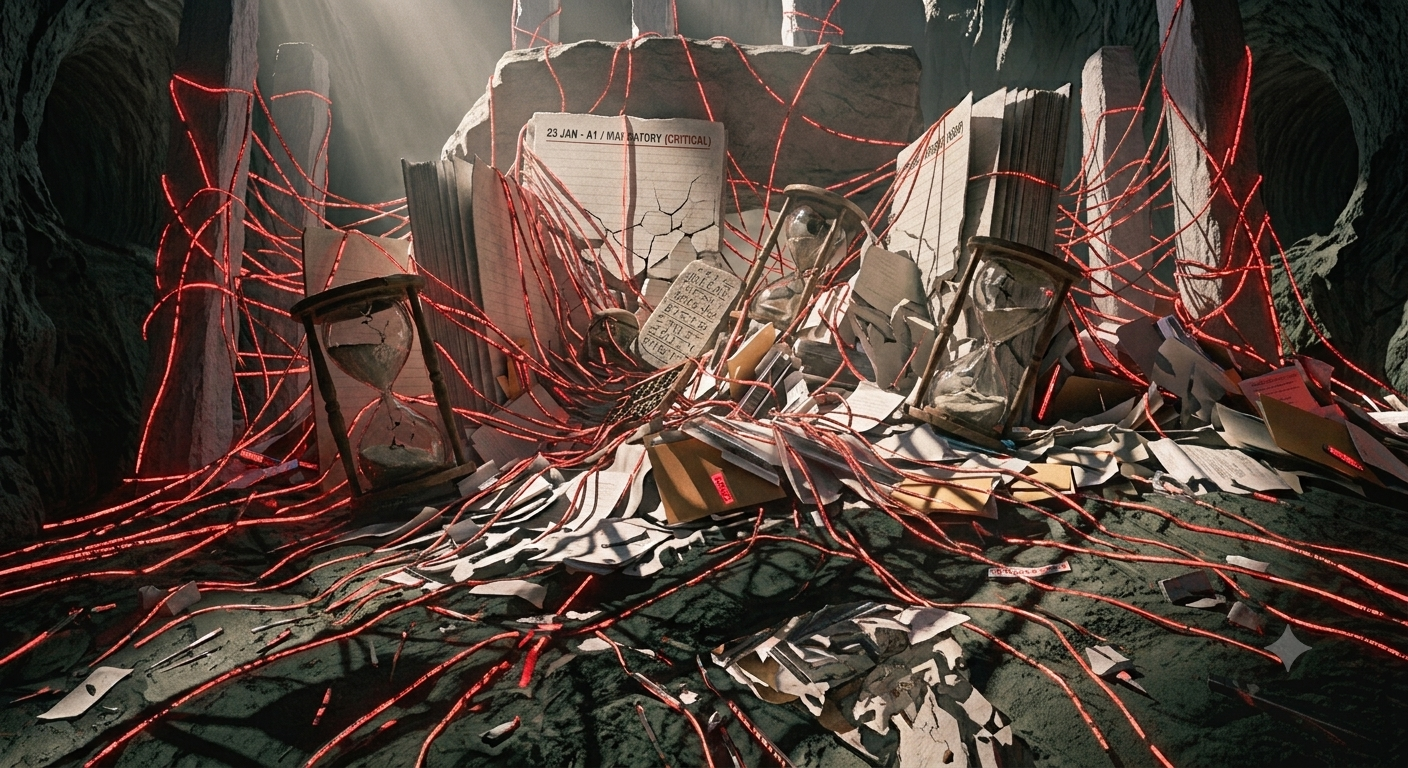
The strange thing about "everything feels urgent" is that it's almost never true — until there's no room left to be wrong about what isn't.
In the last post, I talked about capacity overload — the gap between what's coming in and what's actually sustainable. This post is about what that overload tends to produce once it's been running for a while: a specific, disorienting feeling where nothing seems more important than anything else, and every task arrives wearing the same red-alert urgency, whether it deserves it or not.
What priorities actually need to function
A priority system, underneath all the frameworks and matrices, is really just a ranking. This matters more than that. That matters more than the other thing. It only works if the ranking has somewhere stable to sit — some baseline of "not everything is on fire" for the important things to rise above.
Take away that baseline, and ranking stops being possible in any meaningful sense. If forty things are simultaneously overdue, arguing about which of the forty is most overdue is close to beside the point. They've all already blown past the threshold where prioritization would have helped. At that point you're not prioritizing anymore. You're triaging — which is a different skill, done under different conditions, and exhausting in a completely different way.
Why “the usual fix” doesn't fix it
This is where a lot of well-intentioned advice goes sideways. Someone in priority chaos gets told to adopt a better prioritization method — rank your tasks by urgency and importance, batch similar work, time-block your calendar. All reasonable ideas. All aimed at the wrong layer of the problem.
A prioritization method assumes there's a stable set of things to rank, with enough slack in the system that getting the ranking slightly wrong is recoverable. Priority chaos, as I'm describing it here, usually means that assumption has already failed — there's too much active at once for any ranking to hold for more than a day or two before the ground shifts again. Learning a fancier way to sort an unsortable pile doesn't make the pile sortable. It just gives you a more sophisticated-looking pile.
The tell that distinguishes this from a "real" prioritization problem
Here's a distinction worth sitting with: some people genuinely struggle to judge what matters — they have plenty of room to work in, but they second-guess the ranking itself, uncertain whether task A or task B deserves the top slot. That's a real, different problem, and it responds well to prioritization frameworks.
Priority chaos, in the sense I mean here, looks different. It's not uncertainty about the ranking. It's the ranking itself becoming meaningless because too much is competing for the same narrow space at the top. If you find yourself completing plenty of tasks — genuinely busy, genuinely working — while your biggest, most important projects barely move, that's usually the tell. You're not failing to choose well. You're choosing constantly, reactively, among too many things that all got labeled urgent by the same underlying overload.
There's a specific mechanism that makes this worse for some people than others: interruption doesn't just cost you the time it takes. It costs you the context you were holding when it happened — the why behind the task, the next step you'd already worked out, the thread you were partway through pulling.
This is especially true if your working memory is shorter than average, a common problem for people affected by ADHD (or aging). If reconstructing that context after every interruption is slow or unreliable, then a normal day's worth of interruptions doesn't just fragment your time. It resets your ranking constantly, because you're re-deriving "what matters right now" from scratch every time you get pulled away, instead of picking up where a stable ranking left off. What looks like an inability to hold priorities in place is often just an ordinary interruption rate meeting an extraordinarily expensive recovery cost.
What tends to help
Since this pattern is frequently downstream of overload rather than separate from it, the most durable fix often isn't a better ranking system — it's addressing what's feeding the pile in the first place, which is where the previous post's questions become relevant again.
But there are things that help even before the underlying overload is resolved:
Naming one thing — just one — that would make today feel successful even if everything else went sideways. Not a comprehensive plan. A single anchor point to compare new demands against as they show up.
Making the backlog visible instead of ambient. A pile of undifferentiated "stuff I should get to" living in your head or scattered across three apps is much harder to triage sanely than the same pile written down somewhere you can actually look at it.
And accepting, at least temporarily, that some things on the list simply won't get done in a state of chaos — not because they don't matter, but because clarity has to come before ranking can mean anything again.
The pattern, connected
If Post 1's point was that a priority problem is often a capacity problem in disguise, this is what that disguise actually feels like from the inside: a genuine, exhausting sense that everything is on fire, because — for a while, under enough load — it effectively was.
