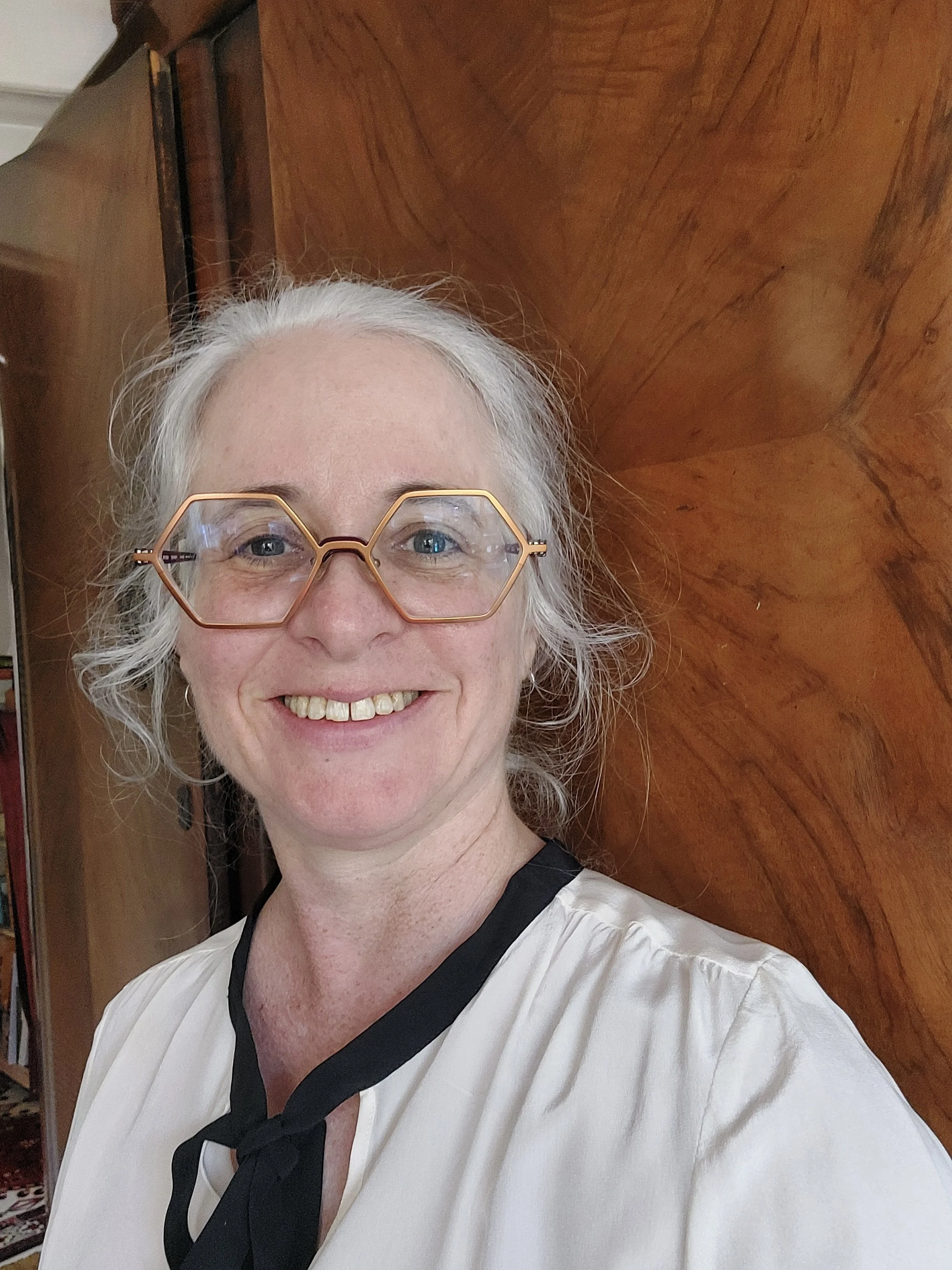
My approach is direct and practical. I'm not here to motivate you or fix your mindset. I'm here to help you figure out what's actually getting in the way — and build something lighter, more honest, and more durable in its place.
I work exclusively with individuals and small groups. I keep it small on purpose.
Hello, I’m Amy
I'm an Agile coach with 20 years of experience — and a neurodivergent brain I've spent most of those years figuring out.
I work with independent professionals, entrepreneurs, and people affected by ADHD who are smart, capable, and privately exhausted by the gap between what they know they can do and what's actually getting done.
My Journey
For a long time, I thought the problem was me.
I was good at strategy. Good at seeing systems, solving problems, generating ideas faster than I could write them down. What I couldn't do was follow through consistently — and I couldn't figure out why.
I read the books. I tried the systems. Most of them worked, for a while, until life happened and everything collapsed again. The cycle was: build something, sustain it briefly, burn out, rebuild from scratch. Repeat. The productivity literature had a name for people like me: undisciplined. I had mostly accepted that.
The turning point wasn't a mindset shift. It was a structural one.
I was working as a software project manager when I encountered Agile — a framework designed specifically to make progress under conditions of uncertainty, interruption, and change. It was built for systems that can't run in a straight line. Which, as it turns out, described me exactly.
What Agile gave me wasn't motivation. It gave me architecture. A way to design around my actual constraints rather than pretending they didn't exist. The impulsivity, the intensity, the nonlinear thinking — those weren't the problem. The mismatch between how I work and how conventional systems are built was the problem.
I spent the next decade stress-testing that insight: studying neuroscience, refining the methodology, and eventually doing this work professionally. The expertise I bring isn't theoretical. It's the product of living this problem for a long time and building something that actually holds.
My Coaching Philosophy
Traditional productivity advice often fails ADHD brains because it assumes a linear, consistent energy flow. My approach is different. It's built on four core pillars:
Strengths-Based
We don't 'fix' you because you aren't broken. We identify your unique cognitive strengths and build systems that leverage them.
Holistic Approach
Your work life doesn't exist in a vacuum. We look at sleep, energy, environment, and emotional regulation as key business metrics.
Action-Oriented
Insight is valuable, but action changes lives. Every session ends with concrete, manageable steps designed for your brain..
Partnership, Not Prescription
I'm the expert on the process; you're the expert on you. We co-create solutions rather than me handing you a generic checklist.
Is This You?
I work best with ambitious, creative individuals who know they have potential but feel blocked by their own operating system.
You have 100 ideas before breakfast but struggle to finish one.
You oscillate between 'superhuman productivity' and 'couch paralysis'.
You feel like an impostor because simple tasks feel impossibly hard.
You're ready to stop fighting your brain and start working with it.
What You Can Expect
Working together is a judgment-free zone. There is no shame here—only strategy.
We'll bypass the generic advice and dig into the specific mechanics of your attention, energy, and motivation. You'll leave with a custom "User Manual" for your brain and a business that thrives because of your unique mind, not in spite of it.
What Is Agile, and How Does it Apply to ADHD?
What is Agile?
Agile is an flexible, empirical approach for getting things done under conditions of uncertainty and change.
Agile derives its name from its core strength: adaptability. Specifically, Agile allows a person to successfully pursue their goal despite uncertainty, interruptions, and changing circumstances. It’s basically the scientific method, customized to your situation, with nested iterations (loops). The point is to slice the uncertain future into manageable pieces, figure out what’s going to help you, and then zero in on your strong points so that you can get as far as you can with the resources you have (whatever they may be). Your resources may be physical, emotional, practical, or social; but they all follow more or less the same rules of consumption, and so can be worked with in more or less the same way.
How is this relevant to ADHD?
Essentially, because life with ADHD includes a great deal of uncertainty and change.
ADHD is a neurological variance which impacts the parts of the brain that help us plan, focus on, and execute tasks. While ADHD confers certain advantages (such as tenacity, multi-tasking, and creative problem-solving) it can also create difficulty with executive functions such as goal-setting, planning, prioritization, task initiation, focus, emotional regulation and working memory. As a result, many of the conventional approaches do not work as well for people affected by ADHD.
What makes Agile ideally suited for ADHD-affected adults?
Agile was designed to require as little working memory and general executive function as possible in order to free up such resources for other tasks.
Here are a few examples of what applied Agile methodology looks like for ADHD:
Agile integrates rhythmic self-correction
The “inspect and adapt” approach so characteristic of Agile was designed to catch the kinds of omissions and mistakes typical of living with ADHD. These cycles serve to constantly scan for impediments to productivity and opportunities for improvement.
Agile teaches better estimation
…Which ADHD sufferers tend to be particularly bad at. The cyclical predict-execute-and-review process provides the necessary feedback for developing this skill. And the experimental structure of Agile facilitates the evolution of a personalized framework to substitute for the NT executive function.
Automation & Delegation
Agile practice emphasizes delegating human work (especially anything boring or repetitive) to automated processes whenever possible. Password managers, automated payments, and other forms of personal automation are immensely helpful in offloading executive function tasks onto more reliable substitutes
Simplification
Agile is largely about the process of breaking down big, uncertain, complicated things into smaller, manageable, simpler things; focusing on and solving each one, then putting the solutions together to achieve a cohesive whole.
Let Me Show You How This Works
Still curious? Maybe you should try it out.
Subscribe to my email list, and I’ll send a tutorial so you can.